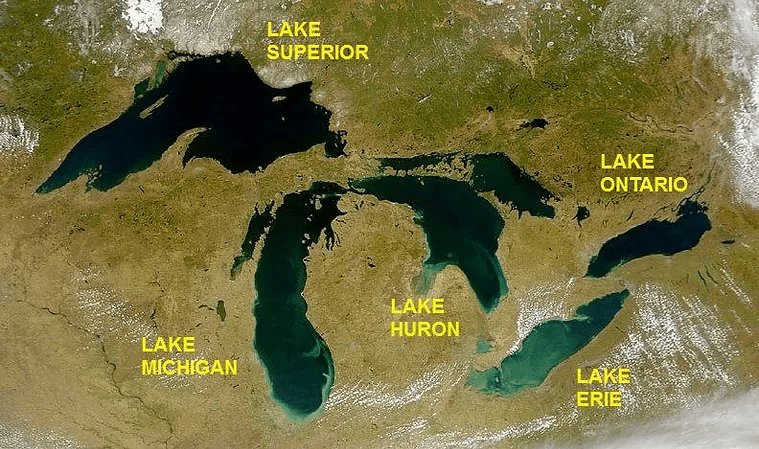
Photo of the Great Lakes. Source: NASA
Often when a body of water is associated with climate change, it’s the ocean. Occasionally, news about a river or small lake drying up will come up, but the ocean takes most of the spotlight and reasonably so for many reasons; ocean acidification, coral bleaching, and rising sea levels are enormous concerns that will affect billions of people. And yet, as someone growing up in the Midwest, I’ve never really felt that connected to the ocean. Instead, for the longest time, I’ve always wondered how the most significant bodies of freshwater, The Great Lakes, will be affected by climate change.
When researching this topic, I found the answer to be simple. According to the EPA, “water levels have declined slightly for most Great Lakes. However, the past few years have shown notable increases toward the top of the historical range” (EPA, 2020). This event, combined with average surface water temperatures, has increased slightly due to higher temperatures in the summer and winter. While a slight lowering of water levels might not seem like a big deal, it is. For example, cargo ships in the great lakes had to reduce their cargo from 5 to 8 percent between 1997 and 2000, which created higher shipping costs according to the EPA, (2020). But as stated previously, water levels have risen to record highs. One researcher at the University of Wisconsin described the phenomenon as, “‘The highs are getting higher and the lows are getting lower,’ Scanlan said,” Tracy (2021). So while lower water levels might affect drinking supplies, high water levels will raise the risk of storm damage to cities neighboring the coast.

Photo of Lake Michigan by Me
Overall, despite the likely increase in storm intensity and occasional lower water levels, the lakes seem to be relatively well off compared to other bodies of freshwater.
Sources
Ben, B. (2021, September 30). The Great Lakes see the impact of climate change: “The highs are getting higher and the lows are getting lower”. CBS News. Retrieved January 15, 2022, from https://www.cbsnews.com/news/great-lakes-climate-change/
Environmental Protection Agency. (2020). Climate change indicators: Great Lakes water levels and temperatures. EPA. Retrieved January 15, 2022, from https://www.epa.gov/climate-indicators/great-lakes
Waldman, A. H. (2020, February 21). Climate change will have a unique impact on the Great Lakes. WGRZ. Retrieved January 15, 2022, from https://www.wgrz.com/article/weather/forecast/climate/climate-change-will-have-a-unique-impact-on-the-great-lakes/71-180bbf59-8743-4570-acf3-c62ce62777ce
 GenZ-Earther
Leave a comment