Oftentimes when we talk about the benefits of the conservation of nature, we talk about all the homes of countless creatures and organisms that were preserved from destruction. Or the beauty that nature provides that we can see and enjoy on our adventures outside. But a lot of people don’t know that nature can have a tremendously positive effect on one’s mental health.
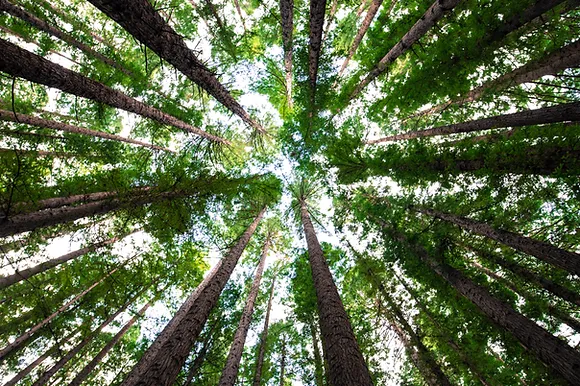
Source: Wix.com
According to researchers at the University of Minnesota, “Being in nature, or even viewing scenes of nature, reduces anger, fear, and stress and increases pleasant feelings” (Delagran). But even this is just the tip of the iceberg when it comes to the benefits that nature provides. For children, nature can be very beneficial to their development, “green spaces near schools promote cognitive development in children and green views near children’s homes promote self-control behaviors” (Schertz, 2019). It is also known that children who grow up in places surrounded by more green spaces will have a lower risk of developing psychiatric disorders when compared to children who don’t. Furthermore, what’s even more fascinating is that early research shows that trees may be known to reduce crime rates in areas where there is a significant amount of trees. In Portland, Oregon, researchers looked at the effects of trees on residential areas. They considered three crime aggregates, “(all crime, violent crime, and property crime) and two individual crimes (burglary and vandalism) ” (Green Cities, 2010). The results indicated that “trees in a public right-of-way area were generally associated with a reduction in crime” (Green Cities, 2010). This evidence was most applicable to areas where the majority of trees were 40ft in height or taller. The reasoning for this evidence was that criminals would assume that a house surrounded by a large number of trees would be better cared for by the owners and be more effectively looked after by neighbors and therefore make the criminals think twice before committing a crime.
Part of the reason why I decided to write this article is that last summer I worked in Keep Indy Beautiful Youth Tree Team. There I operated with a team of 6, including me, where we went around Indy, maintaining its urban forest. These maintenance activities included: pruning, watering, and mulching. It was a lot of fun despite the hard manual labor and I would recommend it to anyone in high school who is potentially looking to pursue an environmentally-related degree in college. Given that trees are effective in lowering crime and Indianapolis has had a rapidly rising crime rate around its inner city, I hope that the young trees I helped to maintain last summer will help just a little bit to put some ease on people’s minds who are living in the Indianapolis area.
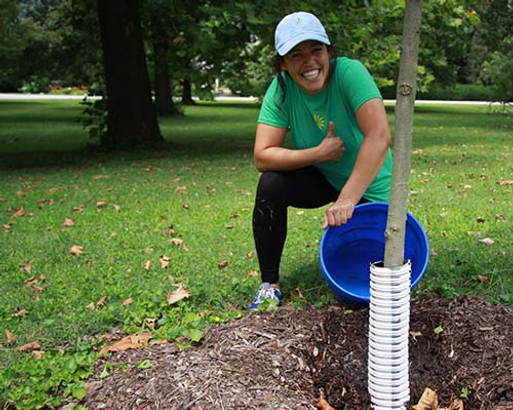
Source: Keep Indianapolis Beautiful
Before you close this article and start heading outside, you might have a few questions on how to effectively get the most out of your nature retreats. For one, how much time outside is enough? UK researchers found that “people who had spent at least two recreational hours in nature during the previous week reported significantly greater health and well-being” (Weir, 2020). Another question you might have is, what is the most beneficial outdoor activity for my health? This is more up to preference. Hiking, walking, gardening, etc will all do you a great benefit, it’s just up to you to decide which one works the most for your lifestyle. Lastly, you may wonder which area of nature may be most beneficial for your mental health. Is it the beach? The forest? Do you need to head to Alaska to see the northern lights in hopes that it will be most effective in curing whatever is prodding your mind? Well, not really. Anywhere works! Just be sure to prepare for whatever you’re going, especially in this summer heat.
p.s. I would recommend bug spray, sunscreen, and water for your next outdoor adventure!
Sources
American Psychological Association. (n.d.). Nurtured by nature. Monitor on Psychology. Retrieved July 10, 2022, from https://www.apa.org/monitor/2020/04/nurtured-nature
Wolf, K. (2010). Crime & Public Safety. Crime and Public Safety :: Green Cities: Good Health. Retrieved July 10, 2022, from https://depts.washington.edu/hhwb/Thm_Crime.html#:~:text=Trees%20may%20reduce%20crime%20by,comparable%20house%20with%20fewer%20trees.
Schertz, K. (2019, June 24). Understanding nature and its cognitive benefits . Sage Journals. Retrieved July 10, 2022, from https://journals.sagepub.com/doi/10.1177/0963721419854100
Delgran, L. (n.d.). How does nature impact our wellbeing? Taking Charge of Your Health & Wellbeing. Retrieved July 10, 2022, from https://www.takingcharge.csh.umn.edu/how-does-nature-impact-our-wellbeing#:~:text=Being%20in%20nature%2C%20or%20even,the%20production%20of%20stress%20hormones.
 GenZ-Earther
Leave a comment