I’m back everyone! It’s been a while since I’ve last posted but I finally have something quite amazing to post about. BATS!!!
This past week I went on a study abroad with Purdue Agriculture to learn about the beautiful country of Pura… uh I mean Costa Rica! I had an amazing time learning about Costa Rica’s people, culture, and environment. This post would be hundreds of pages long if I wanted to talk about everything that I learned about the environment of Costa Rica, so I decided to focus on bats. Last Tuesday, my group and I went to visit a cacao farm where an organization called the Night Wings Project was doing research. The organization is a team of Costa Rican scientists dedicated to learning more about bats and how they benefit humans and the Costa Rican ecosystem.
Let’s start with the basics. Bats are mammals that originate from the order Chiroptera. They are known as the birds of the night. They live almost anywhere in the world except very cold places such as Antarctica and Greenland, however, they prefer warmer areas like the equator (LiveScience, 2018). There are about 1,400 species all over the world but 116 species specifically in Costa Rica. They typically eat a wide variety of fruits and insects for their meals. How many insects do they eat a night you might ask? Lots of them. Specifically between 6,000-8,000 insects per night (aaanimalcontrol, n.d.). So how do they catch these insects? Through the use of echolocation. Each bat species has echolocation at a different frequency but it’s the same function across all of them, they use their echolocation to ping off the surrounding environment in order to figure out where they are. (NPS, n.d.). None of which are audible to the human ear by the way. Anyway, insects, despite their small size, cannot hide from the ping, and once spotted, the bats go in for the kill.

Scientists showing off bat they just caught
Now all of this is very cool, but so what? You might ask. How does this affect us? Well, it affects us in many ways. For example, when it comes to preventing mosquitoes with diseases from coming in contact with people, bats can be the first line of defense. Also, in terms of agriculture, pests consume about 25% of our crops worldwide, and as the global temperature increases that percentage of pests consuming crops will only go up. (Louis, 2018). But bats help to combat this problem. Not only can they save farmers’ crops but their money as well. Because a field protected by bats won’t need any pesticides applied to it. Agriculture can save up to $37 billion in the U.S. alone and $900 billion in the world thanks to our flying friends. When it comes to pollinating, you might think of bees but bats are also very important for pollination as well. According to the Night Wings Project, they pollinate up to 540 different species of flowers around the world. Along with their pollination, they help to distribute the seeds of the flowers that they pollinate, which keeps the flower populations alive and well. (Benefits of bats, n.d.). Their pollination work provides a lot of the food and materials that we depend on, and if they were to go extinct we would lose a lot of nutritional fruits and veggies. (U.S. geologic survey, n.d.).
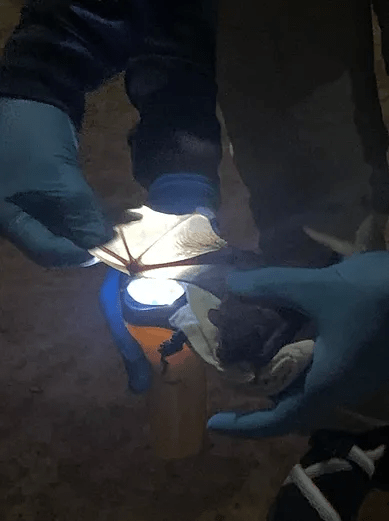
Scientists highlighting the wing structure of a bat
Now for such an important creature obviously we humans are doing our very best job to keep these species alive and well right? Well… not exactly. According to the Night Wings Project, about 1% of all the bats species in the world are extinct. While 10% are either threatened or endangered. And lastly for about 25% of all the bat species, there is not enough data to know, so some could be endangered or extinct or some could be quite well off, who knows? The rest of the bat species percentages are of least concern. Right now the biggest threat to bats is a disease known as white-nose syndrome. It’s a fungus that has been known to kill up to 6.5 million bats so far. It is beyond our control and we can do little to prevent spreading to bats. In second place, is wind power. Wind turbines basically create a low-pressure space in the area where the turbines turn which causes a bat’s lungs to explode. This causes much controversy as wind power is crucial to fighting climate change despite its ability to kill up to 900,000 bats per year. And lastly, the third biggest threat to bats is habitat destruction. Basically as our cities and towns expand, we increasingly intrude and destroy habitat that is home to bats.
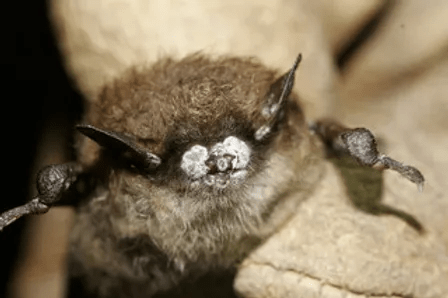
Bat with white-nose syndrome
So what’s all to make of this? Well, it’s imperative that we spread awareness about animal species that are crucial to our survival such as bats. Bringing awareness to these issues helps to shape public opinion. And public opinion can shape public policy in a way that favors taking care of the environment around us.
On a final note, I just wanted to shout out The Night Wings Project. They are an amazing organization and they are doing some amazing work! Here are their social media pages:
https://www.facebook.com/nightwingsproject/photos/
https://www.instagram.com/nightwingsproje/
Sources
Pierre-louis, K. (2018, August 30). The bugs are coming, and they’ll want more of our food. The New York Times. Retrieved March 20, 2022, from https://www.nytimes.com/2018/08/30/climate/insects-eating-more-crops.html#:~:text=Worldwide%2C%20insect%20pests%20consume%20up,Thursday%20in%20the%20journal%20Science.
Why are bats important? Why are bats important? | U.S. Geological Survey. (n.d.). Retrieved March 20, 2022, from https://www.usgs.gov/faqs/why-are-bats-important#:~:text=By%20eating%20insects%2C%20bats%20save,53%20billion%20dollars%20per%20year.
How many bugs per night do bats eat? (2020). Retrieved March 20, 2022, from http://www.aaanimalcontrol.com/professional-trapper/batbugeat.html#:~:text=Just%20one%20bat%20alone%20can,bugs%20each%20night%2C%20PER%20bat.
Bradford, A. (2018, October 24). Bats: Fuzzy flying mammals. LiveScience. Retrieved March 20, 2022, from https://www.livescience.com/28272-bats.html#:~:text=Bats%20live%20almost%20everywhere%2C%20except,%2C%20farmland%2C%20woods%20and%20cities.
U.S. Department of the Interior. (n.d.). Echolocation. National Parks Service. Retrieved March 20, 2022, from https://www.nps.gov/subjects/bats/echolocation.htm#:~:text=Bats%20navigate%20and%20find%20insect,recognize%20their%20own%20unique%20calls.
Benefits of bats – BLM. (n.d.). Retrieved March 21, 2022, from https://www.blm.gov/sites/blm.gov/files/benefits_of_bats_brochure.pdf
 GenZ-Earther
Leave a comment