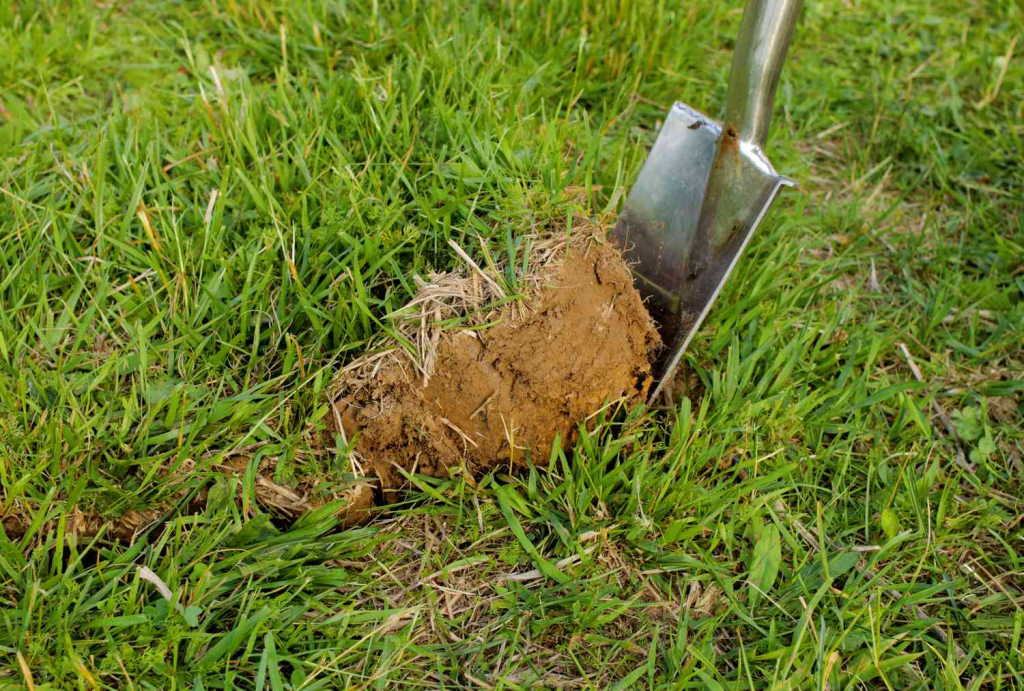
As I was clearing out some of my Google Drive to make some more storage for the future documents and folders that I would be putting in there, I came across an assignment that I had completed two years ago for my environmental policy class. In it, I was supposed to write up an environmental policy suggestion for a fictional or real politician that I wanted to influence. At the time, I had read a lot about grass lawns in suburbia and their negative effect on the environment. So, I decided to pick the environmental policy topic of removing grass lawns… in Texas! Turns out, according to the research I conducted, Texas could definitely alleviate some of the water stress that they are currently experiencing. So I wrote up the assignment, and pretended that I was an expert sending a letter to Texas Governor Greg Abbott.
So, without further a due, here is my policy suggestion, on removing grass lawns.
To: Governor Gregg Abbott
From: Ryland Barton, NRCS Water Conservation Manager
Date: November 29, 2022
Subject: Reducing Strain on Texas’s Water Supply
Suburbs are the bread and butter of middle-class living in the United States. Ever since the 1950s, suburbia has been a staple of the American experience. Living in a big house with a large front and back lawn, surrounded by plenty of friendly neighbors is a dream many Americans strive to achieve or maintain. However, there is just one problem associated with this dream, the grass lawns that are in the front and back of the house. While grass lawns are green in color, it stands in contrast to how environmentally destructive grass lawns are. This staple of middle-class life is not only a detriment to our environment but also a risk to our health, and now more than ever we must as Americans rip out our grass lawns.
The Problem
Grass lawns require a lot of work to irrigate. According to the EPA, Americans use 7 billion gallons of water to irrigate their lawns every day. In the average household, lawn irrigation accounts for 75% of its water consumption (Vercammen, 2022). These statistics are why grass is considered the single largest “crop” in the U.S., except unlike corn and soy, grass provides no purpose other than for aesthetics. Lawn irrigation can be a huge strain to any state, especially for states in arid regions like Texas, where water scarcity is becoming an enormous problem. Everyone in the U.S. deserves access to clean fresh water, but our obsession with managing our lawns degrades the quality of our water and destroys local fish and aquatic habitats. According to the Audobon Society, 70 million pounds of pesticides are applied to our lawns each year (Dray, 2019). While estimates vary, a large amount of these millions of pounds will run off into nearby streams and rivers. The EPA reports that “The use of lawn chemicals accounts for the majority of wildlife poisonings” (EPA.gov). And of course use of lawn herbicides and pesticides doesn’t just affect wildlife, but our companion pets as well. Studies have found that pets with pesticide users have higher cases of lymphoma when compared to those who don’t use chemicals on their lawns. But most importantly, there have been several hazardous health effects for humans that are tied to pesticides and herbicides. The EPA reports that “Several types of cancer, immuno-response deficiencies, neurological diseases, and birth defects have been associated with exposure to lawn chemicals” (EPA.gov). We are quite literally putting local fish, our pets, and ourselves at risk to make sure our lawns look pretty for all our neighbors to see.
Lastly, the maintenance of our lawns contributes enormous amounts of CO2 into the air each year. According to Princeton University, “gas-powered lawnmowers make up five percent of total air pollution in the United States, amounting to even more in urban areas” (Son, 2020). And while this problem could be fixed by just switching to electric lawnmowers, it’s important to understand that electric lawnmowers can still contribute a significant CO2 amount emissions due to where they may get their power when recharging. Also what needs to be included as well are the manufacturing environmental costs that go with making a lawn mower. Simply put, grass lawns are not worth maintaining if it comes to the detriment of contributing to climate change.
Solutions to the Problem
Despite these problems, there is a silver bullet to all of this, we must get rid of grass lawns. The question that stands is how is the government, whether they are local, state, or federal, going to incentivize its citizens to tear out their lawns? In Southern California, local governments are already encouraging citizens to rip out their grass lawns by giving them $6 per square foot (Vercammen, 2022). Furthermore, these citizens are not only being given money but they are saving a ton of money in the long run as well, given that maintaining a grass lawn through irrigation requires a majority of an average household’s water consumption. This extra boost of money in people’s pockets is no doubt helping to boost the local economies down in Southern California. And for the governments, more water is now available to distribute wherever it is needed. The incentivization of not only saving money but being given money to rip out one’s lawns is a sustainable and economic solution to finally ridding ourselves of grass lawns.
Once lawns are ripped out, people will need something to replace them with and luckily there will be plenty of solutions for that. One popular option in arid regions is xeriscaping. Xeriscaping is the process of landscaping an environment with vegetation that requires little to no irrigation. This can be especially beneficial in Texas because xeriscaping allows homeowners to remove the invasive grasses off their lawns and instead replace them with native Texan plants that are acclimated to the heat. So ultimately, the best thing to do after taking out a lawn is to replace it with the environment that was originally there.
Micro farms can knock out two birds with one stone by helping to eliminate food deserts as well as contribute to preserving water usage. And while this may seem like an attractive but unattainable dream it is currently happening in southern LA. Jamiah Hargins, founder of Crop Swap LA, made it his goal to make food more accessible in food deserts. “Hargins wants to empower underserved communities while giving them access to fresh food by planting small, sustainable farms in lots across L.A” (Ramsey, 2021). With his current garden, he’s been able to grow up to 600 plants that can feed up to 50 families at one time. His organization is hoping to grow even more by using more unused space as gardens as well as encouraging other people to transform their front lawns into gardens. They have also been able to employ dozens of people, giving them green jobs in the sustainable farming business. This idea could especially be utilized in the great state of Texas where, “Of Texas’ 258 counties, 58 counties are considered Food Deserts according to the USDA definition and criteria” (CDC.gov). This is backed up by the fact that 1 in 7 Texans are food insecure according to the nonprofit Feeding Texas. Think of how this problem could be eased if the state government began funding nonprofit organizations to help thousands of residents with unused lawns to begin to grow gardens to feed their neighborhoods. Or sort of how residents in California have been encouraged to rip out their lawns with incentives, a similar system could be used to incentivize Texans to grow gardens in their front lawns. While it is not necessary for everyone to start growing a garden for the benefit of the community, encouraging the widespread removal of lawns will allow the practice of micro-farms to take root in Texas and help extend a hand to food-insecure Texans.
Thanks,
Ryland Barton
Works Cited
Centers for Disease Control and Prevention. (2017, July 13). Gis Exchange|Map details – food deserts in texas|dhdsp|cdc. Centers for Disease Control and Prevention. Retrieved November 10, 2022, from https://www.cdc.gov/dhdsp/maps/gisx/mapgallery/tx_food_deserts.html#:~:tex=Of%20Texas’%20258%20counties%2C%2058,with%20four%20or%20more%20employees).
Dray, P. (2022, April 29). Overuse of pesticides doesn’t benefit lawns or people. Milford-Orange Times. Retrieved September 27, 2022, from https://www.theorangetimes.com/overuse-of-pesticides-doesnt-benefit-lawns-or-people/#:~:text=According%20to%20the%20Audubon%20Society,lawns%2C%20mainly%20for%20aesthetic%20purposes.
Lawn Chemicals – US EPA. (n.d.). Retrieved October 6, 2022, from https://cfpub.epa.gov/npstbx/files/lawnchemicals.pdf
Mendez, M. (2022, August 19). Texas is facing its worst drought since 2011. here’s what you need to know. The Texas Tribune. Retrieved September 28, 2022, from https://www.texastribune.org/2022/08/19/texas-drought-water-conservation/#:~:text=In%20Texas%2C%20about%2027%25%20of,to%20the%20monitor’s%20latest%20report.
Son, J. (2020, May 12). Lawn Maintenance and climate change – psci. Princeton University. Retrieved September 27, 2022, from https://psci.princeton.edu/tips/2020/5/11/law-maintenance-and-climate-change
Ramsey, D. (2021, May 13). ‘micro farms’ come to South L.A. frontyards, bringing fresh produce to food deserts. Los Angeles Times. Retrieved November 10, 2022, from https://www.latimes.com/california/story/2021-05-13/asante-microfarms-jamiah-hargins-south-la-fresh-food-produce
Vercammen, P. (2022, August 20). Would you rip up your lawn for $6 a square foot? welcome to drought-stricken California. ABC7 Los Angeles. Retrieved October 1, 2022, from https://abc7.com/drought-california-money-cash/12147371/
 GenZ-Earther
Leave a comment