
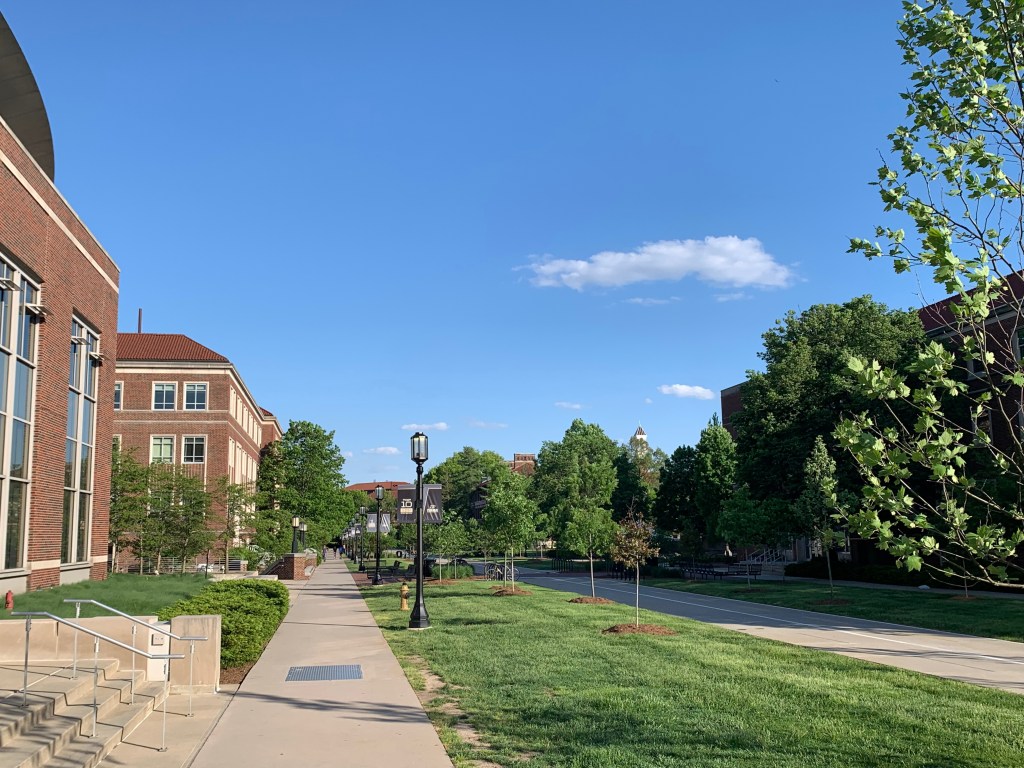
Overview of campus near Elliot Hall. Source: Me.
Students, former and current, we are all learners in life whether we’re in a classroom or not. But this post is primarily for those who are in the classroom or plan to be in one soon, furthering their education. Going to school for an additional 3-4 years after high school is an opportunity that is not for everyone. But even those who choose to go to college, don’t exactly enjoy it or live it to its fullest extent, that is… the academic side at least. This isn’t necessarily to say that there aren’t a lot of bright or naturally curious people who go to university, everyone has something to offer the world once they graduate, but not everyone is clamoring to get a PhD as soon as possible, which is perfectly fine. A liberal arts major will have different aspirations than that of a business major and that’s ok, but they can both share a lack of motivation to show up to class or lab everyday. I too must confess, I often shared that same lack of enthusiasm for showing up to the classroom every week day. However, whereas in high school, where you’re required to show up, the same does not apply to college. You can participate in as little or as much as you would like and you will still pay the same price of tuition. So college presents an interesting dynamic where you have more freedom during the semester, compared to high school, but it’s technically optional to show up to class. And yet, there’s always a running joke about how classes start to thin out after a few weeks into the semester. On top of this, post-pandemic, there’s a chance that your class will now have recordings of the lectures, the lecture slides are always posted, and you can have ChatGPT explain to you any concept or idea in a matter of seconds (not to mention help you write entire essays or answer online test questions for you). So the motivation and the want to go to class is lower than ever before due to the number of shortcuts that you can take.
Purdue Engineering Mall. Source: Me
Looking back at my learning career, if there was one word to describe my time at Purdue, it would be ‘inquisitive’. I asked a LOT of questions during my time at Purdue. In class, over email, in office hours, etc. This is not to say I am some bright young genius on the rise or anything (many of the questions I asked, could’ve been solved by me if I just used my critical thinking skills more) but I’m grateful for each and every question I asked. Because each time, it reaffirmed for me why I was in class…. to learn. However, even then, I waned in my focus on learning. Oftentimes, especially during my first two years at Purdue, I had a completionist mindset. “Just get this assignment, lab report, or study session done and out of my way”, a thought I would think to myself. I would never stop to ask myself why the professor assigned this reflection, assignment, extra-credit activity, lab report, etc. It felt as though I was looking towards the destination of graduation and I just had to hop over a multitude of obstacles (tests and homework) to get there. And within those two years I never thought to ask myself, “why am I doing this?”. It wasn’t until the second semester of my sophomore year that I began to realize the fault in my thinking. Early in the spring semester, for my organic chemistry class, there was an extra credit assignment to see a speaker event. David Macmillian, the 2021 Nobel prize winner in chemistry had come to Purdue to be a part of the president lecture series and speak with our president. The assignment was essentially a reflection on what we had learned during the event. And while I did go to the event for extra credit, I planned to leave before it ended once I answered all the prompts. I stayed the entire time, thoroughly enjoying it. In the end, I felt as if I didn’t care if I got extra credit or not, I learned a lot about what Macmillian had said during his talk. After the event, my phone was buzzing from the organic chemistry GroupMe, everyone was clamoring to make sure all the questions were answered correctly, not a single comment was if any one of them had enjoyed or learned something beyond the reflection question prompts. This singular event changed my view on assignments, extra credit or not, in that I finally saw that they were a task for me to learn and grow rather than waste time on. My enjoyment in learning grew instantly from this revelation.

Purdue Bell Tower. Source: Me
To blame people’s lack of curiosity or disinterest in school outside of obligation to get a diploma would be a faulty assumption, because many would argue that the American education system does not encourage these fundamental feelings when it comes to learning. When learning becomes all about getting a certain letter grade, most people aren’t going to care about the journey but the result. And from elementary onwards, that carries over to college. However, people like learning, but oftentimes with the internet it is easy to learn about something that is not true or not learn the entire truth about something. Millions of people will watch and enjoy a 30 second clip of a pseudo science guru on some podcast, talk about a study in a dishonest or mal-intent manner, and take what the guru said to heart rather than actually read the study and understand the entire picture. This demonstrates that people like to learn but at best, in a manner that is not effective at understanding the whole picture and at worst in a manner that is completely wrong.

NRES Forestry Products Building. Source: Me
There needs to be a reorientation of how students, from elementary to college, should view school. School should not be seen as an obstacle in one’s path to eventual freedom. It’s a staircase that leads you into becoming a better developed, more intelligent person. It gives you the foundation of a house, and then grants you the tools to construct the house into whatever you want it to be. The house being your goals and aspirations for what you want to do within your career. Colleges and universities, in particular, have a number of advantages in regards to being able to reorient students in an effective manner that will bring them to classes more often as well as want to participate in learning as much as they can within the university. For one, they can select the students that they think will want to go above and beyond in their learning experience when it comes to admissions. Two, they often have the financial resources and wealth to be able to invest in a culture that rewards being academically curious. And three, investing more in the students now will mean that when the students become future alumni, they will reinvest in the university monetarily. However, they also have an obligation to do so. Universities have come under rising scrutiny about the cost of tuition as well as if a university degree is really as valuable as it was before. In an age where the entire world and its knowledge is at your fingertips, colleges need to demonstrate that it can provide you with the support to become an overall better person when compared to not going to college. All that being said, the door can be opened for you as wide as possible, but it is on YOU to want to walk through it.
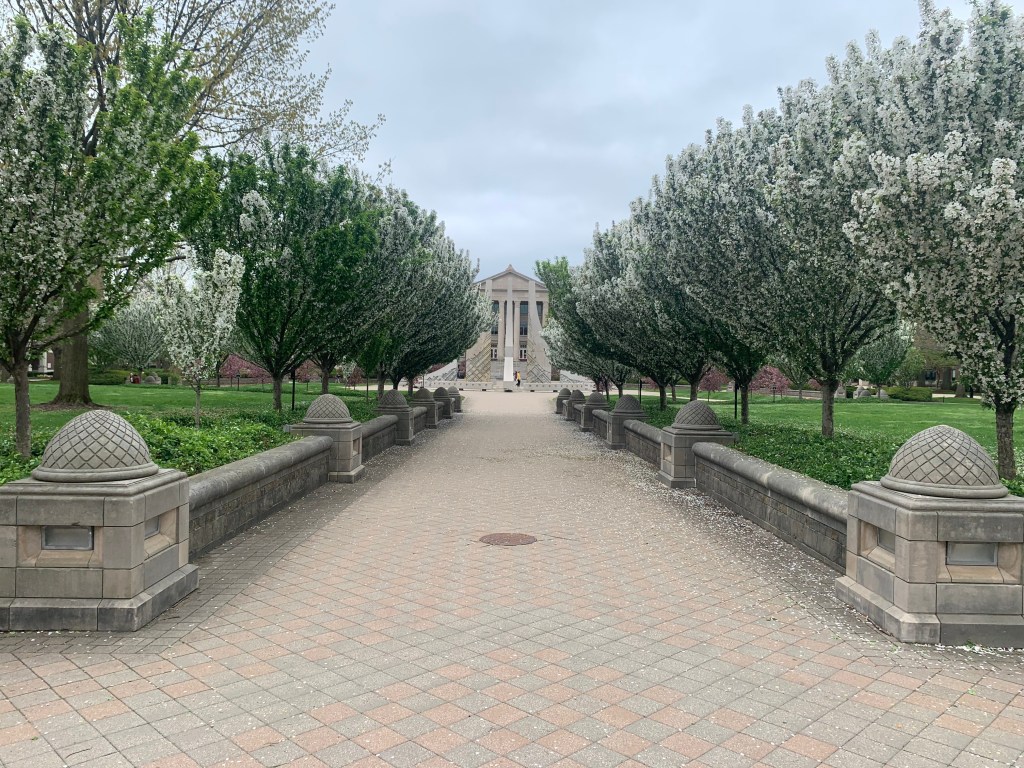
Purdue Engineering Fountain. Source: Me.
So, to those who continue to learn, no matter the learning environment. Ask yourself, why you’re putting yourself in that classroom whether it be virtual or physical. Ask yourself what you hope to get out of it, and how it will aid you in your future journey. The intended result from these questions will hopefully be a reconstructed view of education, and just maybe, a raised hand asking the instructor for more insight.
Congratulations to my fellow 2025 grads!
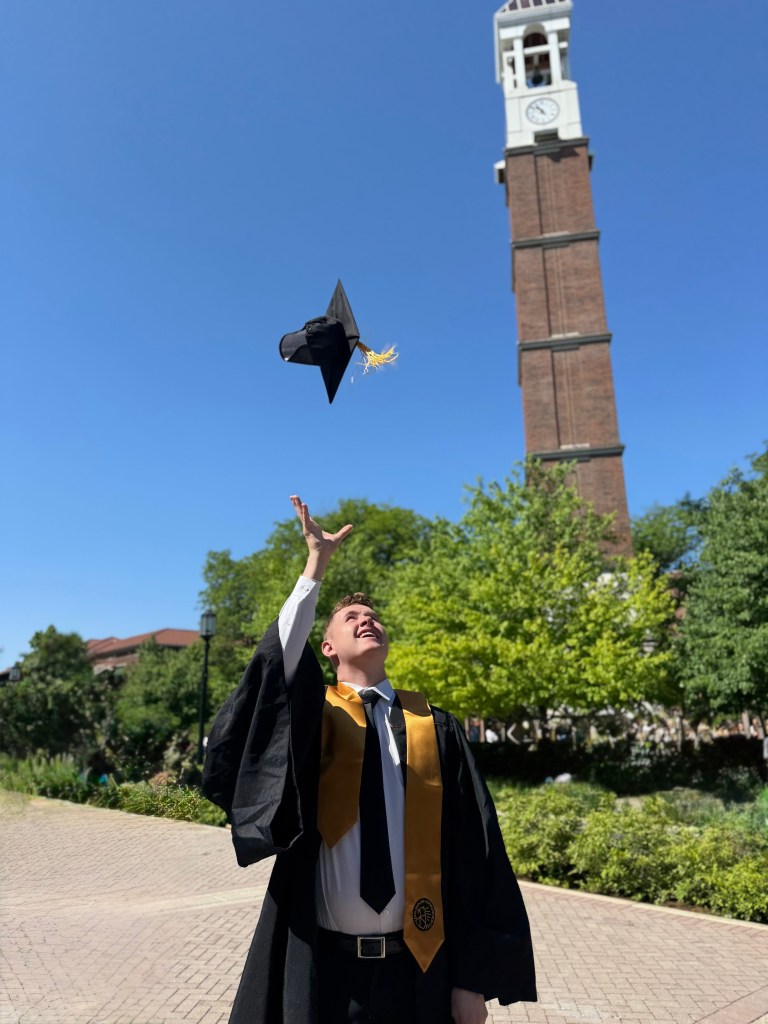
Photo of me: Source: My sister
 GenZ-Earther
Leave a comment