By Ryland Barton
This past spring, I had the privilege of going to the country of Panama with my family for spring break. We landed in Panama City and settled into a one night stay at a hotel right beside the Pan-American highway that overlooks Panama bay. While the view of the bay was great, the incessant hum of engines and the occasional honking made the ambience a lot less pleasant despite the beautiful view. But the next day was one of the most memorable times of the vacation. When I woke up, I remember opening the blinds of the hotel door to see the Pan American highway, empty of cars. In their place, were groups of joggers and bicyclists going about their day exercising along the highway. The city had shut down the road for a couple of hours to allow for a walk/bike highway event at the time but it was absolutely breathtaking just how much more peaceful and quiet the area was. A space, reclaimed for pedestrians and bicyclists, even if it was just for a short time, made me realize how normalized it was to have cars in places they really shouldn’t be.
Before
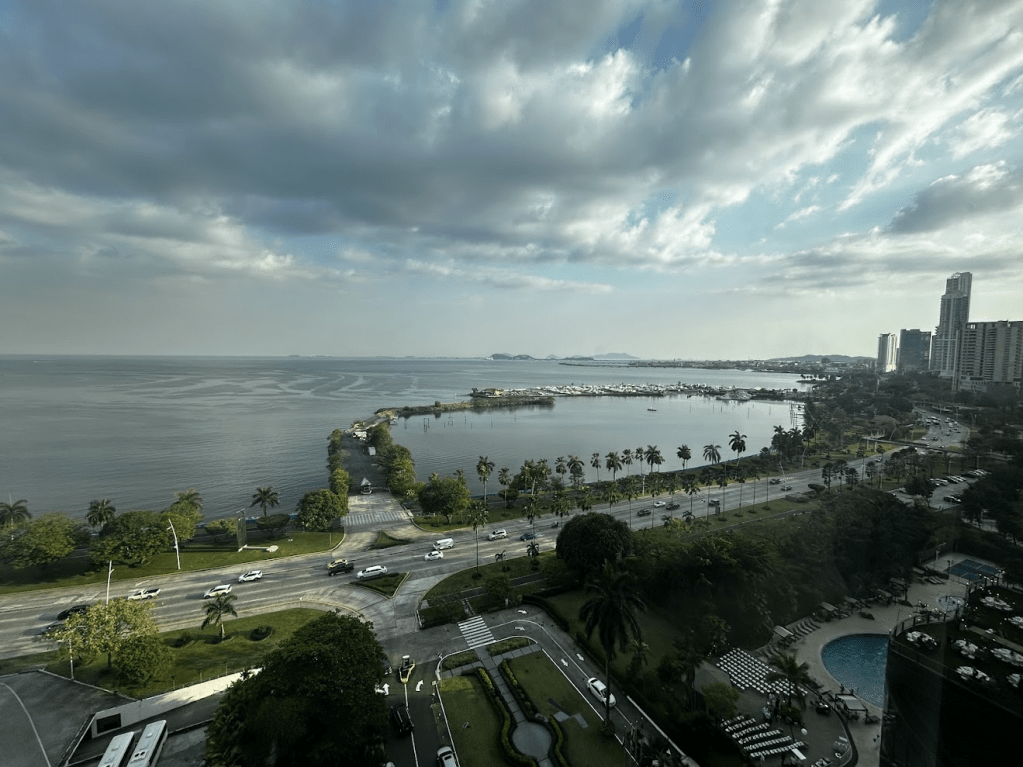
The Pan-American Highway With Cars on it (Source: me).
After
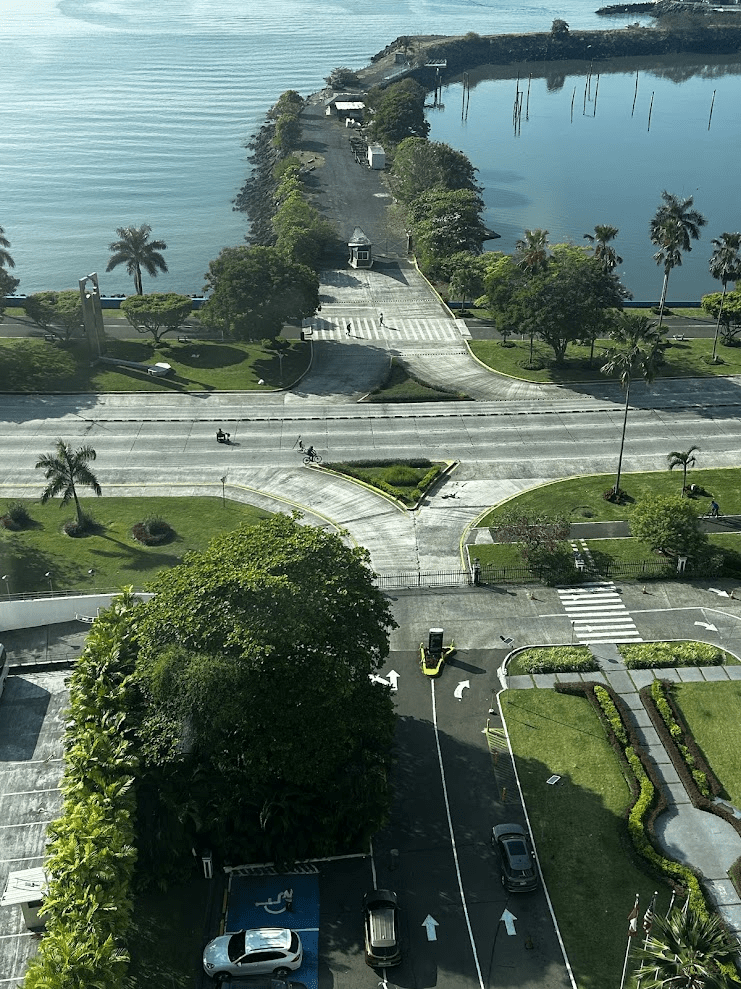
The Pan-American Highway Without Cars on it (Source: Me).
If you ever take a second to become present and aware of all your senses, you start to pick up on things you don’t usually notice. When it comes to hearing, there’s a lot of sounds that you neglect to pay attention to just out of convenience for your mind. But sound can play a large part in your physiological health. To oversimplify it, the sounds you hear travel from your ear to the auditory cortex, a section of the temporal lobe. Once it reaches that part, it then travels to your amygdala, which is the emotional processing center of your brain (Gallagher, 2025). From there, your brain decides which signals to send out based on the sounds it hears. That’s why a loud and sudden sound will make you jump and look around in fright, because your brain is trying to prepare you for fight or flight. Or, when you’re out in nature and you can hear the birds sing and the wind in the leaves, you relax because they are natural sounds (Gallagher, 2025). And while this can consciously be noticeable when you are awake at night, these triggering sounds can also affect the health of your sleep, especially when your body requires much quieter noise.
The majority of sounds you hear can depend on where you are, whether it’s your house, a park, a coffeeshop, or something else. But I’m willing to bet, if you took yourself to each of these locations, there would be one sound in the subtle or noticeable background that would be continuous across them. The sound of cars. Tires hitting the road, engines revving past, horns honking in the distance, car sounds are the most intrusive sound in our day to day life. Especially in America, where our cities and towns have been paved over and broken up for car infrastructure, it is inescapable. But this distinct sound does not just threaten the peace and silence in America, but every country in the world that has a growing urbanized population. Even areas that have stood the test of time across thousands of years of human history are plunged into this intrusive modern noise.
One of the most popular sites to visit in the world are the Pyramids of Giza. The UNESCO World Heritage Site sits right next to the bustling metropolis of Cairo, Egypt. While the city is known to have many attractions, fantastic cuisine, a picturesque view of the Nile, and the pyramids. It’s also known for being the second loudest city in the world according to the World Hearing Index (Tawfeek, 2018). At number one, is even an older city, Guangzhou, the loudest city in the world, but each of these cities have one thing in common, a horrendous amount of car traffic. While this can mean a variety of typical consequences such as high rate of car accidents and fatalities, poor air quality, and long driving times getting from one city to the next, most people don’t usually account for the high risk of accelerated hearing loss. To put it on an audio scale, the average scale in Cairo is at about 90 decibels (db), rarely dipping below 70 db. This is the equivalent of living inside a factory (Tawfeek, 2018). This issue goes beyond just the top two cities of Cairo and Guangzhou but in cities as a whole, where people on average lose hearing that is equivalent to someone who is 10-20 years older than them (Tawfeek, 2018).

Traffic in Cairo (Source: MuslimMatters.org).
Going beyond just hearing loss, this issue can affect cardiovascular health, cognitive performance and growth, as well as sleep and metabolic function. When you think of the causes of heart disease, what do you usually think about? Fast ultraprocessed food? A lack of exercise? Mental stress? Well, sound can also be a significant health risk to heart disease. In the state of New Jersey, researchers from Rutgers University found that high noise exposure was attributed to be the cause of 1 in 20 heart attacks (Ho, 2022). On a more global scale, the World Health Organization (WHO) has identified ‘traffic noise’, meaning the sounds coming from cars, planes, and trains as the second most leading cause of ill health in Western Europe (European Environment Agency). And while yes, trains, buses, planes, and other forms of public transport do contribute to the noiseiness of an area, they are far less frequent and abundant than cars. Furthermore, in certain instances, steps can be taken to reduce the sound coming from public transport. In the Dutch city of The Hague, several areas that contain tram tracks, are underlined with grass to provide a number of benefits, but most notably, reduce sound pollution from the trams (Patowary, 2013).

Grass Covered Tram Tacks in The Hague (Source: Me).
Beyond just the physiological effects on our bodies, the threat of manmade cars threatens the natural world as well. The rise in the frequency of loud and disturbing man-made noises can affect the natural world in a variety of ways from predators being able to hear prey, the ability of female birds to hear mating calls, and their ability to sleep (NPS, 2025). From state parks, to national ones, to public lands, it’s getting harder and harder for one to completely separate themselves from the manmade world into the natural one. No matter how pretty the scenery can be, unwelcome noise can always disturb the awe of seeing it. While the growth of urbanization is inevitable due to a growing population of 8 billion, oftentimes cities do not prioritize smart growth, growing out instead of up. Oftentimes what is driving this is car infrastructure. A section of a highway in Houston can be about the same size as the city of Siena, Italy, a city that holds up to 30,000 people.
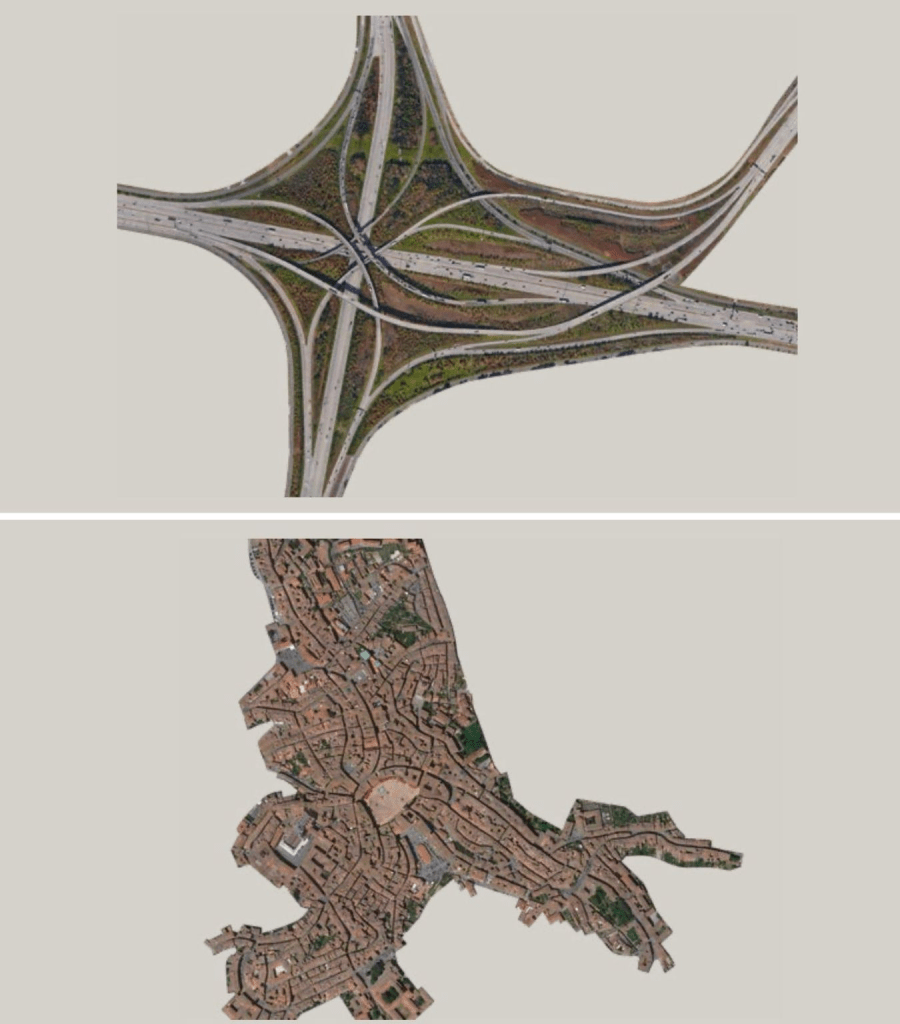
On top, a section of a highway in Houston, below, Siena, Italy (Source Unknown).
But we can stop this spread of unwanted noise. By reclaiming the spaces that were once for humans but instead were given to cars. We can reimagine urban spaces to be places for walking and business, without the traffic. Enacting stricter regulations and monitoring measures on removing a muffler from one’s car so that cars aren’t excessively louder than they are supposed to be. In the city of Barcelona, so-called ‘superblocks’ have been set up in certain areas of the city which are specifically designed to block out traffic noises by creating pedestrian only areas. Spanish researchers found that these superblocks could help to prevent up to 700 premature deaths if the planned construction of more superblocks is planned later on in the city (Mueller, 2020). Events like Bike the Drive Chicago, created by the Active Transportation Alliance, a nonprofit bicyclist advocacy group, help in opening up people’s eyes to a world without cars. In my own city of Carmel, over the past decades, numerous infrastructure improvements have made the city one of the most pedestrian and bicyclist friendly areas in Indiana. Off of city center drive, what was once a strip mall parking lot, is now being used to create multipurpose housing which includes condos, rental units, restaurants, and car parking. This helps to increase the density of amenities in one area, further encouraging people to walk and bike to areas near them, rather than being forced to drive. Remembering that urban spaces are supposed to be built for humans, instead of cars, can be a motivating factor to push for reclaiming space that was once ours.
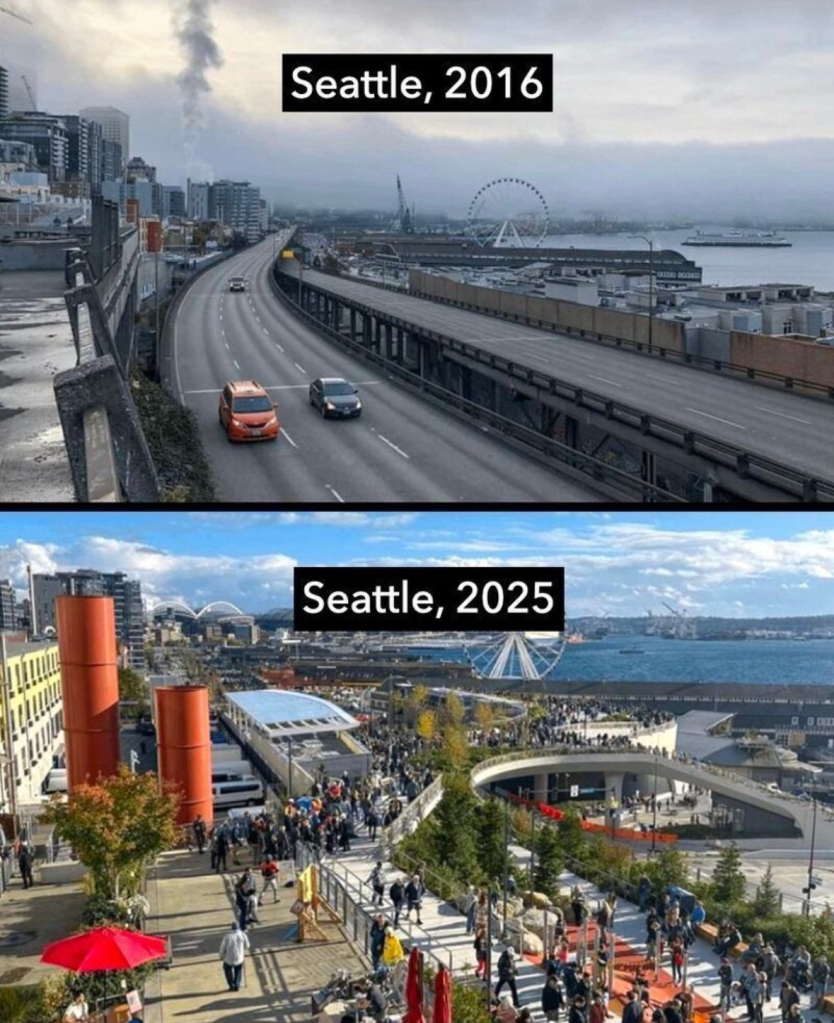
The Alaskan Viaduct Way transformed into a waterfront district (Source: Unknown).
Sources:
https://www.eea.europa.eu/themes/human/noise/noise-2
https://www.bbc.com/news/articles/crmjdm2m4yjo
https://www.nps.gov/subjects/sound/effects_wildlife.htm
https://www.sciencedirect.com/science/article/pii/S0160412019315223
https://www.amusingplanet.com/2013/06/grass-covered-tram-tracks-in-europe.html
 GenZ-Earther
Leave a comment